
How to Help Your Baby Sleep Well

It's important to start good sleep habits early. Your baby's first year is a good time to start bedtime and naptime routines. This will help prepare your baby for good sleeping habits throughout childhood.
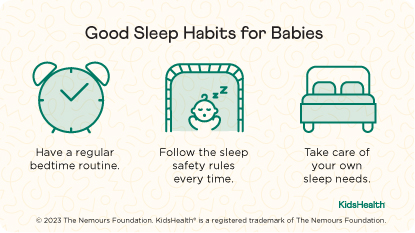

Good sleep habits for babies. Keep a regular routine. Always follow safe sleep rules. Take care of your own sleep needs.

Instructions

  • Make a regular bedtime routine. It should include quiet activities such as bathing, changing diapers, reading, or singing.
  • Put your baby in the crib, bassinet, or portable crib when they first become drowsy, but when your baby isn't yet asleep. This way, your baby can learn to fall asleep on their own.
  • Feed or nurse your baby before putting down to sleep. Do not put your baby to bed with a bottle of formula, milk, or juice.
  • To help prevent sudden infant death syndrome (SIDS):
    • Always place your baby to sleep on their back.
    • Put your baby in a crib or bassinet that meets all safety standards. Never put wedges, sleep positioners, pillows, blankets, bumpers, or toys in the crib or bassinet.
    • Keep the crib or bassinet in the room where you sleep. Don't have your baby sleep in bed with you.
    • Breastfeed your baby, if possible.
    • Give your baby a pacifier at nap and at bedtime. If your baby is breastfeeding, wait until breastfeeding is going well before using a pacifier, usually when your baby is about 3–4 weeks old.
    • Don't let your baby get too hot while sleeping. Keep the room at a temperature that is comfortable for a lightly clothed adult.
    • If your baby falls asleep in a car seat, stroller, sling, or baby carrier, move them to the crib or bassinet as soon as possible.
    • Don't let anyone smoke around your baby.
    • Make sure everyone who cares for your baby follows these safe sleep practices.
  • When your baby wakes at night to feed, keep the lights low and your voice quiet. Feed your baby, change the diaper if needed, then put your baby right back in the crib, bassinet, or portable crib.
  • If your baby is older than 1 month and your health care provider says it's OK, let your baby fuss for a few minutes if they wake at night. This gives your baby a chance to settle and fall back asleep without you. 
  • If fussing is louder or longer than usual:
    • Check on your baby. Make sure that your little one isn't hungry or in pain, and does not seem sick. Change the diaper if it's bothering your baby.
    • If everything is OK, soothe your baby without picking them up. Try rubbing your baby's back or singing quietly.
    • When your baby is calm, leave. Let your baby try to fall asleep without you.

Call Your Health Care Provider if...

  • You have questions or concerns about your baby's sleep.

More to Know

How much sleep does my baby need? Infants up to 3 months old sleep about 14–17 hours a day. Babies 4–12 months old need about 12–16 hours a day. At first, babies may sleep only an hour or two at a time, and their sleep is usually spread throughout the day and night. But as babies grow, they usually start sleeping longer, with more sleep taking place at night.

Learn More

