
Viral Conjunctivitis: How to Care for Your Child

Viral conjunctivitis (pinkeye) causes watery, itchy, irritated, red eyes. Viral conjunctivitis usually gets better on its own. Until then, keep your child comfortable and help prevent spreading it to other people.

Care Instructions

  • Clean the eyelashes and eyelids gently with warm water and clean cotton balls or gauze, when needed.
  • If it is soothing to your child, place a cool or warm compress (a clean washcloth soaked in water) on the eye area. Use a fresh washcloth each time and for each eye.
  • If your child is uncomfortable, your health care provider may recommend acetaminophen (such as Tylenol® or a store brand) OR, for children over 6 months, ibuprofen (such as Advil®, Motrin® or a store brand).       
  • Do not give aspirin to your child or teen, as it has been linked to a rare but serious illness called Reye syndrome.
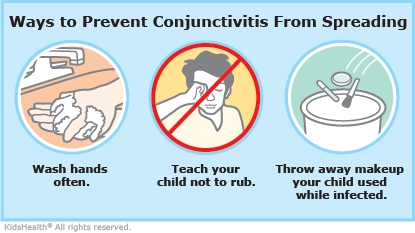
  • To help prevent the spread of conjunctivitis to others:
    • Wash hands often with soap and warm water. This is especially important after cleaning or soaking the area around your child's eyes. If soap and water are not available, you can use an alcohol-based hand sanitizer. 
    • Help your child avoid touching or rubbing the eyes.
    • Don't let your child share towels, pillows, eyeglasses or cosmetics.
    • Wash sheets in hot water and detergent. Be sure to wash your hands after handling the dirty laundry.
    • Don't let your child go in swimming pools until symptoms are gone.
  • To prevent conjunctivitis from coming back:
  • Your child should not wear contact lenses until all symptoms are gone and the health care provider says it's OK.
    • Throw away any contact lens solution, disposable contact lenses, and cases your child used while the eyes were infected. Clean extended wear contact lenses as directed.
    • Clean all eyeglasses, sunglasses and cases.
    • Change pillowcases and towels often until symptoms are gone.
    • Throw away all makeup your child used while the eyes were infected.
  • Check with your health care provider about when your child can return to child care, school or work.

Call Your Health Care Provider if...

Your child:

  • has yellow or green mucus coming from the eye, or the eye gets very red
  • has a fever
  • does not get better after about a week
  • has trouble seeing
  • is sensitive to light
  • has eye pain

Go to the ER if...

  • Your child has redness and swelling around the eye.

More to Know

What is conjunctivitis? Conjunctivitis is inflammation (irritation and swelling) of the conjunctiva, a thin clear layer that covers the white part of the eye and inner eyelids. Viral conjunctivitis is caused by a virus (a type of germ). When inflamed, the conjunctiva becomes red or pink, which is why conjunctivitis is often called "pinkeye."

Kids with viral conjunctivitis may have watery and itchy eyes. The eyes may burn or sting or feel as if there's sand in them. Sometimes there is a small amount of stringy mucus, which can cause some kids to wake up with their eyelids stuck together.

Viral conjunctivitis may start in one eye but often both eyes are infected within a few days. Some children may have a fever, sore throat, swollen glands, or cold symptoms along with the conjunctivitis. Symptoms can take 1–2 weeks to go away.

Is conjunctivitis contagious? Viral conjunctivitis is very contagious, and can easily spread from one person to another. This usually happens after someone touches the tears, eye discharge, or mucus of an infected person and then touches their own eyes. Viral conjunctivitis usually is contagious for about 7–14 days, until the eyes are no longer red or making extra tears or mucus.

How is conjunctivitis treated? Usually no testing is needed and viral conjunctivitis gets better on its own. Antibiotics will not help it get better.

Learn More


